Nozzle-Jet-Impingement Liquid Cooling

MezzoFluidics Eliminates Cold Plates and TIMs

Eliminating the cold plate and the thermal interface materials (TIMs) gives direct access to GPU to increase thermal efficiency by 30-40%. Coldplates were a great replacement for air cooling ... Now they are Obsolete... See Discovery (1)
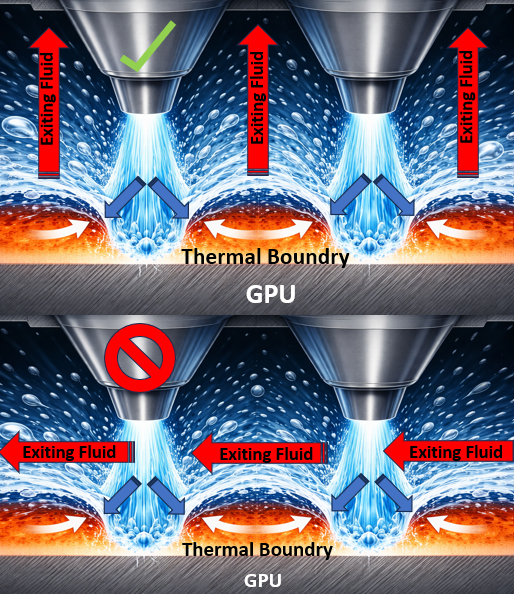
MezzoFluidics’ patented nozzle-jet-impingement cooling delivers industry-leading thermal performance at extremely low CDU pump pressures. In controlled testing, the architecture demonstrated surface-to-coolant thermal resistance below 0.008 C/W (limited by ±0.3°C temperature accuracy) at under 1 L/min flow and approximately 1 psi inlet pressure—surpassing conventional microchannel cold plates and commercial GPU water blocks by multiples, while enabling simpler plumbing and lower system power. Nozzle-jet-impingement inner sidewalls directs the cooling fluid directly where it is needed and nozzle-jet-impingement exterior sidewalls eliminates exiting fluid entrainment not requiring high pressures. This continously resets the "Wall" or thermal boundry layer on the top surfaces of the GPU and High Bandwith Memory (HBM) in 2.5D and 3D chip and chiplet stacking.
MezzoFluidics hero story image
Problem
Illustrative visualization of thermal challenges in the evolution of advancing semiconductor devices.
Why Nozzle-Jet-Impingement Cooling Is Fundamentally Different

Unlike microchannel cold plates that rely on long flow paths and high pressure drop, MezzoFluidics uses discrete nozzle-impingement-jets to directly impinge coolant onto the heat-generating surfaces... directly to GPU and High Bandwidth Memory (HBM) chips.

Each impinging nozzle-jet locally disrupts and resets the thermal boundary layer, preventing the downstream performance degradation inherent to flow-over cooling. This approach delivers highly uniform cooling with exceptionally low thermal resistance.

Boundary layer reset, simply: each nozzle-jet continuously wipes away the insulating near-wall layer and replaces it with fresh coolant—restarting heat transfer at its maximum value.

Fluid Flexibility

Validated Performance at Low Flow and Pressure

< 0.008 C/W (limited by ±0.3°C temperature accuracy)
Surface-to-coolant thermal resistance
< .87 L/min
Total coolant flow rate! Plenty of "Headroom" for future GPU's thermal loads greater > 3500 watts. The actual Thermal Resistance(Tout-Tin)/Watts= 0.0148 C/W giving more "Headroom" for the advancing GPU thermal loads. With the small fluid cavity open design and the channelizing surfaces, dual exit ports, moves the cooling fluid through the thermal management fixture very rapidly.
≈ 1 psi
Inlet pressure was 0.76 psi and with the two exit cooling ports at <0.0 PSI due to a syphon effect. The fact that the pressure is so low leaves plenty of "Headroom" for the larger thermal loads predicted to reach 3500 watts and larger. This also helps CDU manufacturers because lower pressures reduces power costs and increases CDU longevity.
Performance claims are based on controlled laboratory testing under defined thermal loads and flow conditions. Reported values are conservatively stated and limited by instrumentation accuracy.

Lower Pump Power

Reduced CDU system energy consumption and simpler pumping requirements compared to high-ΔP channel architectures and nozzle-jet sidewalls eliminate exiting fluid entrainment. Dual cooling fluid exit ports reduce and or eliminate back pressure to 0 PSI or negative by syphon assistance.Therefore, drastically reduces the chance for any leaks.

Logical Symmetrical Flow Patterns

Open-cavity and channelized flow regions are designed to minimize fluid-handling complexity and prevent jet interference. In many jetted cold plates, high-density jet columns impinge on the heated surface, but the exiting coolant must cross active jet streams, causing entrainment and flow interaction. In contrast, the MezzoFluidics nozzle-jet-impingement array provides dedicated escape pathways for the exiting fluid, allowing it to flow upward and between nozzle sidewalls and into channelized regions of the nipple-plate plateau. The exiting fluid is never entrained into the primary cooling jets.

Scalable Architecture

Applicable to next-generation GPUs and accelerators where heat flux and uniformity are critical, currently can handle thermal loads greater than 1500 watts. Nozzle-Impingement-Jets can be sized to cover assymetrical hot spots on GPU surfaces and differential nozzle heights to address 2.5 and 3D chip chip stacking.

Technical Explainers

Left: Technical explanation. Right: visual reference. Click Advance to step through paired frames.

Loading…

Permanent link
Technical visual 01

Advantages · Benefits · Regulations

Select a topic on the left to view detailed content on the right. assets/abr_XX.txt files.

Loading…
Permanent link
All content is for informational purposes only. Specifications and availability are subject to change.